
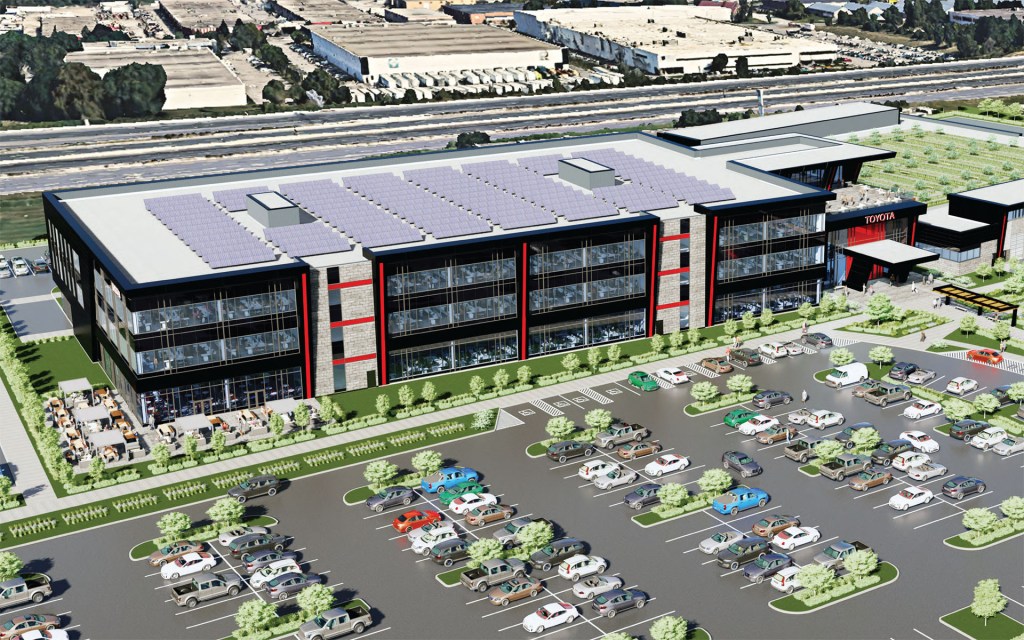
Canada’s largest producer of vehicles is planning to spend hundreds of millions of dollars to grow its business across the country.
Toyota said it will spend more than $300 million over the next three years to construct three new facilities.
The new facilities include a new head office, and two new parts distribution centres.
“Today’s announcement represents a significant investment in our future in Canada – our business, our people, and our long-term success,” said Cyril Dimitris, president and CEO of Toyota Canada, in an April 14 news release.
“This investment is part of Toyota’s ongoing commitment to Canada, creating spaces and operations that improve how we support our dealers and customers, encourage collaboration and enable continued growth across our business.”
New head office in Toronto
The new head office will occupy the same address as the current one at 1 Toyota Place in Toronto, Ont.
Toyota Canada’s new head office will be 225,000 square feet and will include the company’s sales, marketing, distribution, service and training activities under one roof.
Toyota Credit Canada Inc., which is located in Markham, Ont., will relocate to the new building in Toronto.
New parts distribution centres
Toyota Canada said it will build two new parts distribution cents in Western Canada, one in Surrey, B.C., and another in Calgary, Alta.
They will replace the company’s current Western Canada parts distribution centre in Richmond, B.C.
The new British Columbia parts distribution centre is expected to open in December 2028. The building will have 210,000 square feet of space and sit on an 8.1-acre parcel of land.
The new Alberta parts distribution centre will have a size of 220,000 square feet and sit on a 13.5-acre parcel of land. It is also expected to go into operation in 2028.
Toyota Canada said the two new facilities will create more opportunity for growth and will help shorten parts distribution times to dealers and customers in Western Canada.
Green and accessible
All three new facilities are being designed with an aim of being environmentally friendly and accessible.
Each one is expected to achieve the Canadian Green Building Council LEED v4 Gold and Net Zero Carbon Building – Design certifications, which would make them among the most environmentally friendly buildings of their kind in the country.
They’re also being designed to achieve the Rick Hansen Foundation Accessibility Certification program’s gold rating for accessibility.







Leave a Reply