
The Lamborghini Miura has been called one of the most beautiful cars in the world – it has even been mentioned by GQ magazine on its lists of most stylish vehicles ever made several times.
It is not the earliest mid-engine sports car but is widely considered the first supercar, the car that began the era of high-performance mid-engine sports cars.
The Miura is also turning 60 years old in 2026, as the car debuted in March 1966 at the Geneva Motor Show.
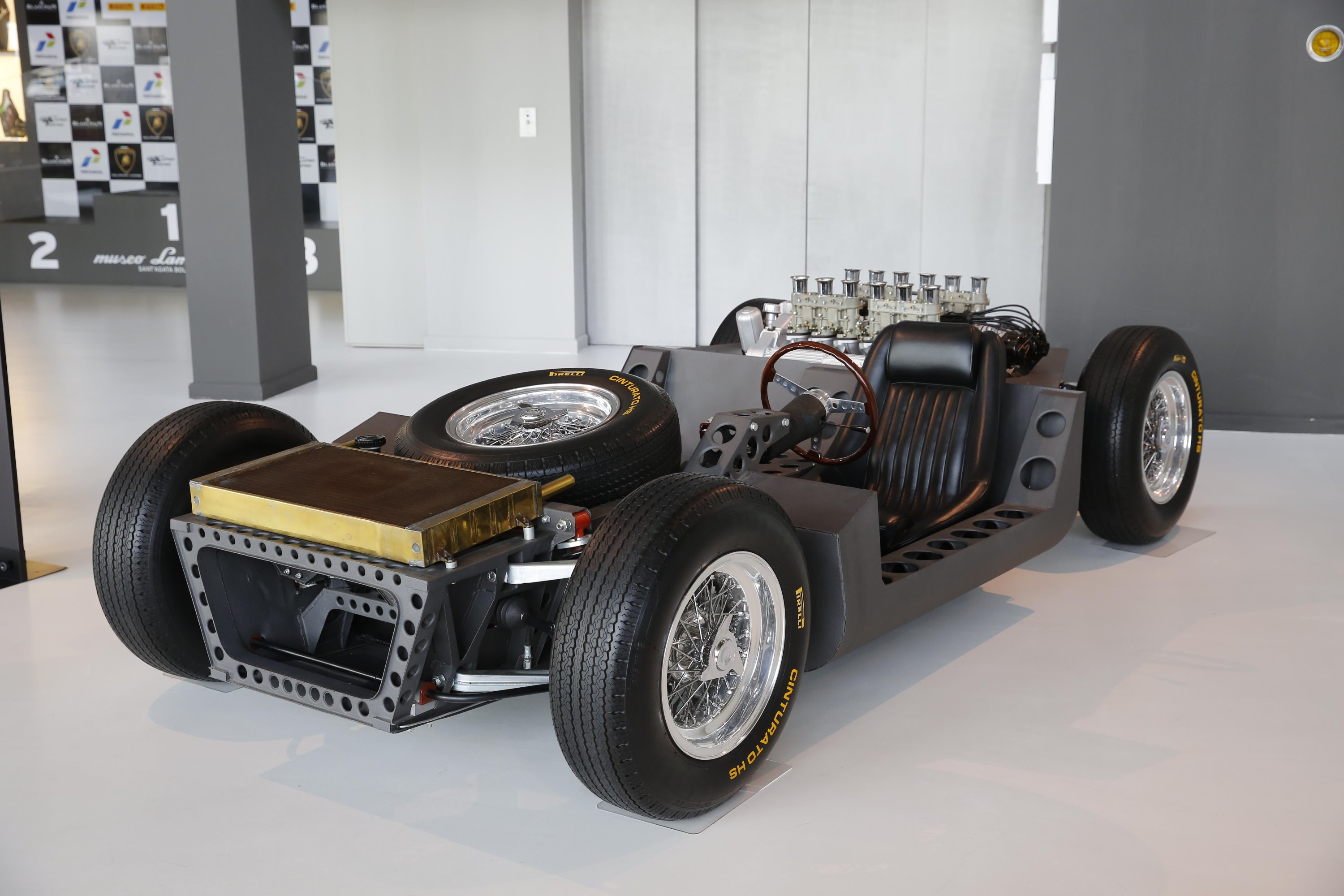
But the car had been captivating observers even before it gained the curvaceous body it is known for, as its chassis was a work of wonder that was shown publicly even before the car took shape.

History of P400 chassis
Here’s a bit of history on that P400 chassis on which the Miura rode.
Three individuals at Lamborghini’s Sant’Agata Bolognese facility, Giampaolo Dallara, Paolo Stanzani and test driver Bob Wallace, all of whom were still in their 20s, had hoped to bring Lamborghini into racing.
However, as racing was not part of Ferruccio Lamborghini’s plans, the trio decided to bring track performance to road cars.
With that idea, they worked on the L105 project, and created a small and lightweight chassis that could host a gran turismo body.
While reluctant at first, Ferruccio Lamborghini let the project continue, and the P400 chassis and engine were created.
The chassis was built by Marchesi, a Modena-based car engineering company. It utilized 0.8-millimetre sheet metal, which was folded and drilled. The automaker said the chassis was both light and rigid.
The chassis had a central tub, to which the mounting base for the suspension was connected, and there were front and rear subframes, to which mechanical components, suspension and accessories were connected.
The chassis weighed less than 120 kilograms.
Various components derived from racing were utilized, including an independent double-wishbone suspension, Girling disc brakes and Borrani wire wheels.

What made the chassis distinct is that the engine and gearbox were integrated into a single compact unit behind the cabin.
The automaker said this reduced the size and established a new powertrain architecture.
At the rear, the chassis came with four exhaust pipes and an engine with 12 vertical inlet carburetor trumpets showing to the world the car meant business.
The P400 chassis was publicly unveiled on Nov. 3, 1965 at the Turin Motor Show and is said to have captivated the public and the press.

No body to go with the chassis
Automobili Lamborghini said Italy’s most important coachbuilders came by the Lamborghini stand at the auto show.
Carrozzeria Touring, who had built the Lamborghini 350 and 400 GT cars, came up with a car design, but financial troubles got in the way of that idea.
Pininfarina was busy on other vehicle projects.
So, automobile designer Nuccio Bertone stepped up.
Even the folks at Lamborghini today can’t say for certain if this truly happened or if it is just legend, but apparently Ferruccio Lamborghini greeted Bertone by saying, in jest, “You are the last of the coachbuilders to show up.”
Bertone is said to have replied by saying he would create “the perfect shoe for this wonderful foot.”
Bertone created the first sketches over the Christmas holidays and showed them to Ferruccio Lamborghini as well as to Dallara and Stanzani. His design was immediately approved.

Miura takes shape
The “perfect shoe” for the P400 chassis was unveiled not long after, as mentioned above, in March 1966.
An English journalist, at the time, used a term for the car that had not been used before: “supercar.”
While modern Lamborghinis are far more advanced in every regard than the Miura, the basic formula for building supercars is little changed to this day.
Celebrations
Lamborghini plans a year of 60th anniversary celebrations in 2026, including an official Polo Storico tour to the Miura.



 Empty Tank
Leave a comment