
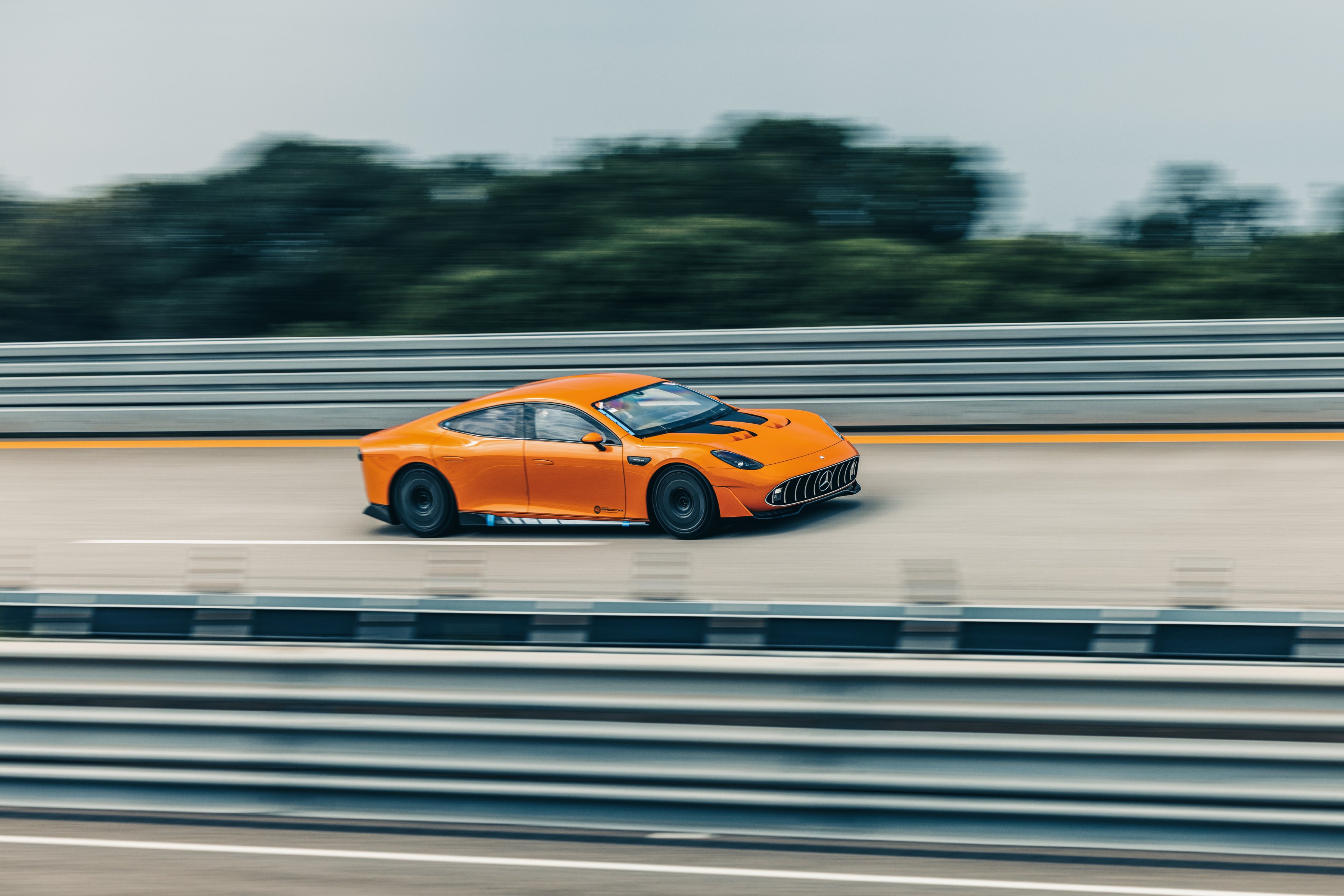
The folks at Mercedes-AMG are showing off the potential of the company’s future high-performance EV by trouncing a bunch of distance records in a concept car.
The Concept AMG GT XX beat more than 25 distance records, Mercedes-Benz said, including how much distance it could cover in 24 hours and how quickly it could drive the equivalent of circling the Earth.
The records were beaten at a high-speed test track in Nardò, Italy, where the company ran two cars, side by side, to prove that the feat wasn’t just a fluke. The driving teams worked in relay and the cars were only stopped to recharge.
The team drove the car a distance of 5,479 kilometres in a 24-hour period. The previous record for furthest distance driven in a full day was less than 4,000 kilometres.
The team also had a goal in mind, to get “around the world in eight days,” essentially doing so in one-tenth the time it took the characters in Jules Verne’s famous novel, “Around the World in 80 Days.”
The team managed to travel 40,075 kilometres, the equivalent of the Earth’s circumference at the equator, in a time of seven days, 13 hours, 24 minutes and seven seconds.
Obviously, there were no jungles to cross, trains to wait for and women to save along the way, but the test is a showcase of how durable the cars are at prolonged high speeds and frequent fast charging.
The around-the-world goal was completed in the morning hours of Aug. 25.
Both cars were able to beat the eight-days-around-the-world goal, with the second car being behind by 25 kilometres, or about two laps of the track.

How the feat was managed
The drivers piloting the cars changed shifts every two hours.
The cars were driven at a speed of 300 km/h, lap after lap, day and night, for eight straight days, stopping only to recharge.
The car is capable of driving faster, but driving the car at 300 km/h proved to be the optimal balance between speed and charging stops, which helped get the company achieve such a distance in 24 hours, Mercedes-Benz said.
The cars recharged at average speeds of 850 kW, which is way faster than what’s currently available in the real world. Typical Level 3 charging speeds range from 50 to 350 kW at publicly accessible charging stations.
Mercedes-Benz said charging at speeds of 850 kW for just five minutes is enough energy for approximately 400 kilometres of range.
“Mercedes-AMG and Formula 1 stand for innovation, intense competition, and pushing the boundaries of what is technically possible. Our company’s powertrains achieved groundbreaking successes in the very first road races in automotive history more than 120 years ago and have set benchmarks for decades,” said Markus Schäfer, chief technology officer, development and purchasing, Mercedes-Benz, in a news release.
“In the 1970s and 1980s, Mercedes-Benz was a regular guest here at Nardò, setting numerous international speed and track records – most notably with the C111 as a visionary technology program. Back then, we demonstrated the performance capabilities of innovative diesel and petrol powertrains. Now, with the Concept AMG GT XX technology program, we are entering a new dimension of performance – this time with fully electric drive. The goal is to redefine the limits of what is technically possible in the age of electric drives. So what could be more fitting than to go chasing records once again? Our mission: to redefine the very standards of performance with groundbreaking technologies and innovations. The motivation and dedication of the cross-functional team from Mercedes-AMG, Mercedes-Benz, Mercedes-Benz Mobility, and our F1 engine experts at Mercedes-AMG High Performance Powertrains throughout the entire preparation phase were boundless. I am immensely proud of the unprecedented achievement of the entire team in this unique record drive.”

Other records broken
The Concept AMG GT XX set the following battery-electic vehicle distance records:
- 2,000 kilometres – 08h:40m:34.22s
- 3,961 kilometres – 17h:14m:42.06s (length of Route 66)
- 5,000 kilometres – 21h:54m:47.48s
- 7,300 kilometres – 1d:08h:07m:58.11s (approximate distance of all races in an F1 season)
- 10,000 kilometres – 1d:20h:10m:00.45s
- 20,000 kilometres – 3d:16h:41m:52.75s
- 21,196 kilometres – 3d:22h:03m:22.22s (length of the Great Wall of China)
- 25,000 kilometres – 4d:15h:44m:51.02s
- 30,000 kilometres – 4d:15h:44m:51.02s
- 40,000 kilometres – 7d:13h:02m:59.47s
- 40,075 kilometres – 7d:13h:24m:07.10s
- 2,000 miles – 0d:14h:03m:10.25s
- 5,000 miles – 1d:11h:27m:03.47s
- 10,000 miles – 2d:23h:15m:45.04s
- 15,000 miles – 4d:11h:52m:28.70s
- 20,000 miles – 6d:00h:23m:07.85s
- 25,000 miles – 6d:00h:23m:07.85s
The car also managed the following time records:
- 12 hours – 2,749.924 kilometres
- 24 hours – 5,478.881 kilometres
- 48 hours – 10,859.526 kilometres
- 72 hours – 16,250.444 kilometres
- 96 hours – 21,632.451 kilometres
- 120 hours – 26,807.575 kilometres
- 144 hours – 32,099,133 kilometres
- 168 hours – 37,259.955 kilometres

The Concept AMG GT XX is built on the AMG.EA electric vehicle architecture, which will be used for production vehicles starting next year.
The concept car utilizes three axial flux motors and a high-performance battery, which Mercedes-Benz said enables continuous power and ultra-fast charging.
The concept car has 1,341 hp (1,360 European horses) and a top speed of 360 km/h (223 mph).

 Empty Tank
Leave a comment