

A few dollars separate the starting Canadian prices of the 2026 Kia EV9 and 2026 Hyundai Ioniq 9.
I can’t tell you which is better as I’ve never driven either, but I can help you compare the price differences between the two low-cost three-row electric vehicles.
The EV9 has been available in Canada for a few years and the Ioniq 9 is new for 2026.

First, what are they?
The all-electric SUVs ride on the same Hyundai-Kia Electric Global Modular Platform (E-GMP) and are probably the two cheapest three-row EVs available in Canada.
I say “probably,” because, as of this writing, there are no cheaper three-row EV options in Canada; however, it’s conceivable other automakers could announce cheaper models or reduce prices on existing vehicles to undercut the EV9 and Ioniq 9. There is also another three-row EV available in Canada that is only slightly more expensive than the EV9 and Ioniq 9, but we’ll get to that one later.
So, what are the price differences between Kia and Hyundai’s large EVs?


EV9 vs. Ioniq 9 prices
The 2026 Hyundai Ioniq 9 has a starting manufacturer’s suggested retail price of $59,999 while the 2026 Kia EV9 has an MSRP of $59,995. At first glance, that gives the Kia a price advantage of four bucks, but not so fast.
The MSRP doesn’t include the various fees and levies dealers charge for administrative costs and destinations charges. Despite the Kia’s lower MSRP, after fees and levies are included, it comes in with a slightly higher final price, at least based on both car company’s online configurators.
The Kia EV9 comes in at a cash price of $63,175, while the Hyundai Ioniq 9 can be had at a cash price of $62,775, saving you a few hundred bucks. Keep in mind, fees and levies may vary by location. If you’re serious about buying either one, check with your local dealer for exact price.

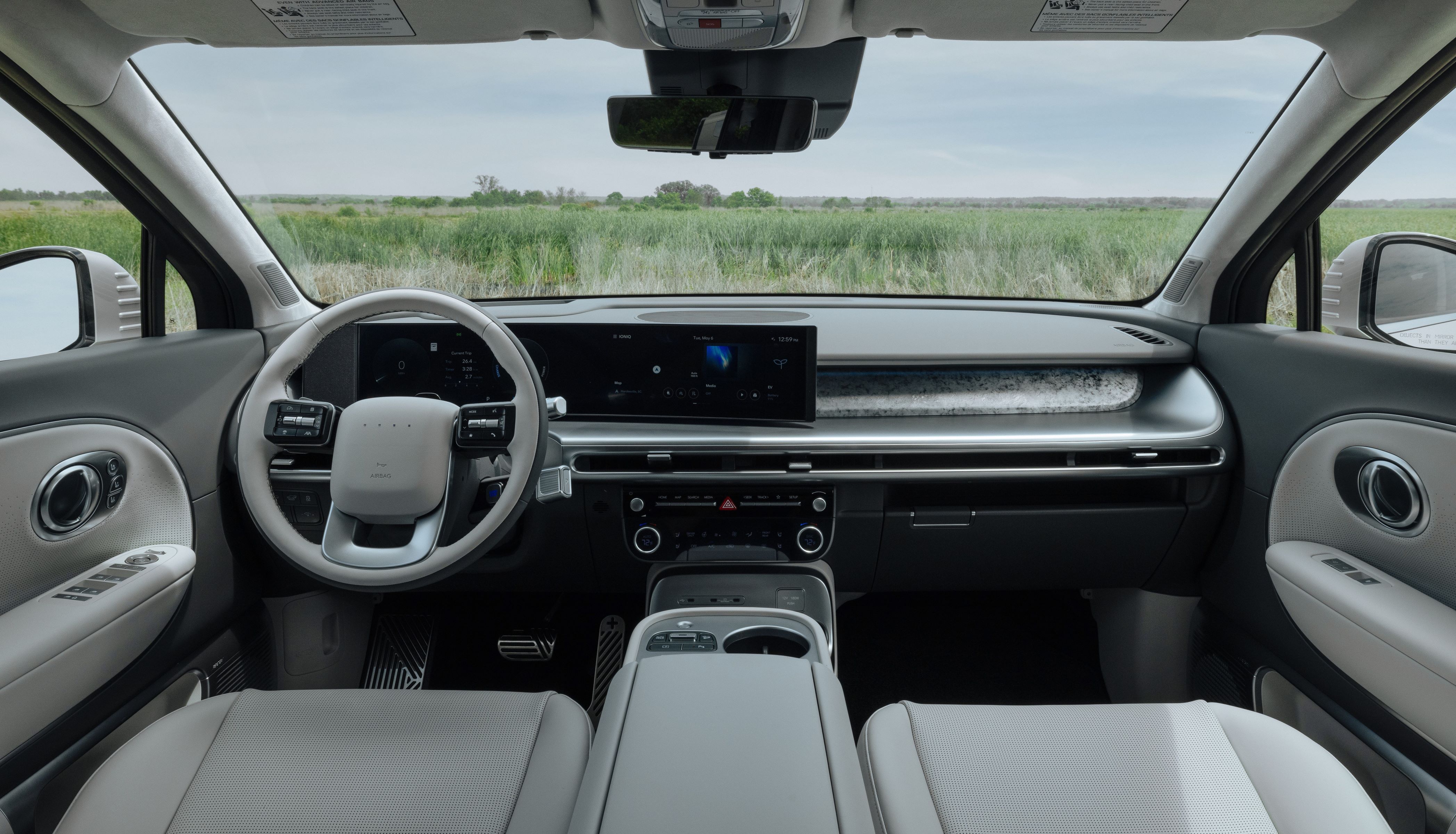
Differences
Like I said up top, I can’t tell you which vehicle is better, but we can explore some of the on-paper differences.
The base model of the Ioniq 9 has a rear-wheel-drive propulsion system with 215 hp getting its motivation from a 110.3-kWh lithium-ion battery. It has an estimated driving range of 539 kilometres.
The base model of the EV9 has a rear-wheel-drive propulsion system with 215 hp with a lithium-ion battery with a capacity of 76.1 kWh and an estimated driving range of 370 kilometres. With the Kia, you’d have to move up to one of the more expensive trims to get battery capacity of 99.8 kWh and a driving range of nearly 500 kilometres.
Vehicle dimensions are similar. The Kia EV9 is 5,010 mm long and 1,750 tall, while the Hyundai Ioniq 9 is 5,060 mm long and 1,790 mm tall. Both seat seven.
On the tech side, both vehicles have numerous safety and comfort features, including a pair of 12.3-inch screens, one for the driver display and one for the infotainment on the centre console.
Of course, if you need more power and more features, you can move up to more expensive trims of either vehicles to get more of everything.
You can configure your Ioniq 9 on the Hyundai Canada website and you can configure your EV9 on the Kia Canada website.
Other low-cost option
The other relatively low-cost three-row EV option, which was hinted at up top, is the Mercedes-Benz EQB, although only 2025 prices are available currently.
The base model EQB 250+ has starting MSRP of $59,990, but that’s for the five-seat option. The third-row seating option adds $1,100 to the price, bringing your MSRP to $61,090.
This gets you a front-wheel-drive three-row electric SUV with 188 hp and an estimated range of 404 kilometres.
You can build your EQB on the Mercedes-Benz Canada website.




 Empty Tank
Leave a comment