
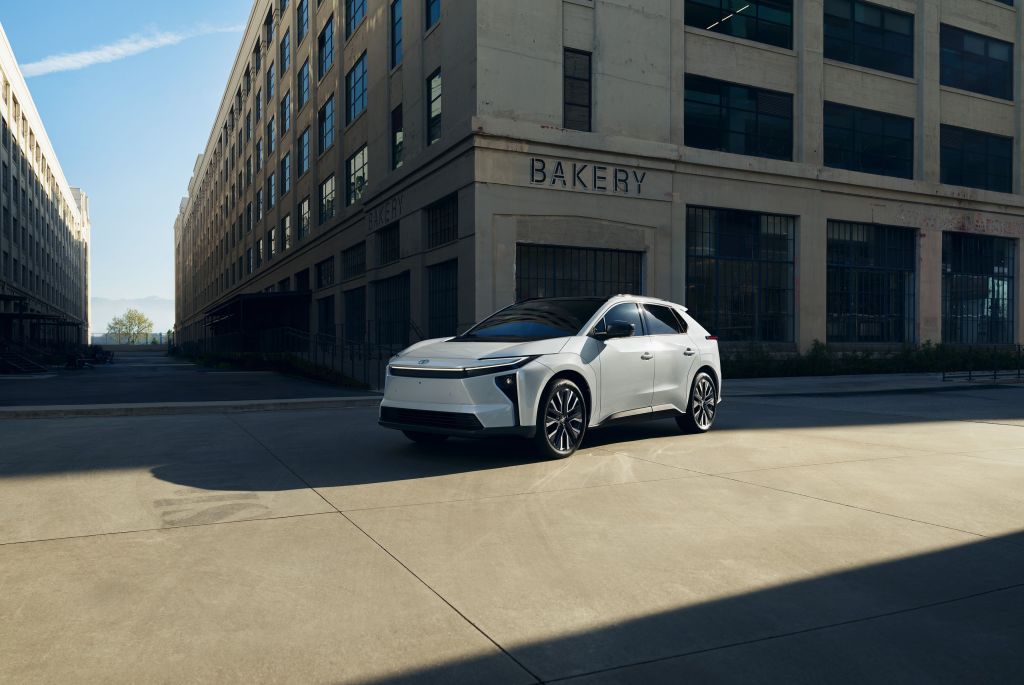
I don’t know when leaders of automotive companies got it into their heads that vehicle names should consist of a series of letters and numbers, but Toyota’s electric SUV has perhaps the most egregious of names.
The seemingly random alphanumeric name probably has some meaning that a Toyota executive probably could explain, but thankfully they no longer need to because someone with influence at the automaker has finally seen to changing the name.
As of the 2026 model year, the Toyota bZ4X will simply be called bZ. It’s still just a collection of letters, but half as many is only half as bad, which, really, is twice as good.
The compact electric SUV is getting a face lift to go with its new name, bringing a series of improvements over the current bZ4X, with possibly the most noteworthy upgrade being to its electric powertrain.

More power and range
The new bZ is seeing improvements in driving range, power output and charging speed.
The 2026 bZ will be available in XLE, XLE AWD and Limited AWD trims.
The SUV will be available with a 57.7-kWh battery on the front-wheel-drive XLE model while the all-wheel-drive grades will get a larger lithium-ion battery with a capacity of 77 kWh.
Toyota estimates AWD XLE models with the new battery have a driving range up to 460 kilometres, and the Limited AWD model’s estimate range is 430 kilometres.
The XLE FWD model has an estimated range of 378 kilometres.
The current bZ4X has a range of 367 to 406 kilometres.
Toyota said the SUV’s lightweight eAxles have been upgraded, now using silicon carbide semiconductors to deliver higher power.
Power on all-wheel-drive models is increasing by 50 per cent to 338 hp. This will give all-wheel-drive bZ models a zero to 100 km/h sprint time of 5.1 seconds, Toyota said.
The front-wheel-drive model is actually losing power, dropping down to 168 hp compared to 201 hp on the bZ4X, which may explain why driving range is increased compared to the existing model.

Improved charging
The bZ comes standard with a North American Charging Standard (NACS) charging port, giving it access to Tesla Supercharger high-speed charging stations.
Toyota estimates with DC fast-charging, the bZ can charge from 10 to 80 per cent in about half an hour.
At-home charging will also be improved.
The bZ is getting an 11-kW on-board AC charger (up from 7 kW), which means it will also be able to charger quicker on a Level 2 charger. Level 1 charging is also available.
The charge port on the bZ is now on the front right side of the vehicle and it comes standard with a dual-voltage charging cable.
The bZ also gets a standard battery pre-conditioning function on all grades, allowing for fast charging in colder weather. This function can be set manually or automatically through the navigation settings.

Control regenerative braking
Drivers will also be able to control the level of regenerative braking via steering wheel paddle shifters. This means drivers can control how much energy the vehicle captures through regenerative braking based on their preference.
If you are wondering why drivers wouldn’t set this to the max, the brake pedal feel may be different than on a car without regenerative braking – some people may not like it. Having control on this feature allows drivers to pick their desired level of charging level and brake pedal feel.
There’s also a battery thermal management system, which helps reduce energy consumption, especially in cold weather, when using power for functions such as heating and cooling, heated and ventilated seats, heated steering wheel, foot and leg heater, and more.
X-Mode
The SUV’s X-Mode allows the driver to select a drive mode for the road conditions.
One example of an X-Mode function is a new Grip-Control feature, which increases off-road performance at low speeds by preventing slipping on rough roads.
The bZ has 206 mm of ground clearance.

Other changes
The new bZ gets other changes over the outgoing bZ4X.
The SUV gets an updated design inside and out, including a new front-end with a new fascia.
On the inside, there’s a new, slimmer dashboard and a new centre console intended to make digital devices easier to use.
A 14-inch multimedia screen is now standard across the model range.
Other features include front and rear ambient lighting with 64 colours, dual wireless smartphone chargers, heated SofTex-trimmed three-spoke steering wheel and a multi-information display that’s up on the dashboard, plus many other features.
All models also get the Toyota Safety Sense 3.0 suite of active safety and driver assistance features.
Full model details can be found on the Toyota Canada website.
The 2026 Toyota bZ is expected to be available in the second half of 2025 in Canada. Pricing will be announced closer to the vehicle’s on-sale date.
 Empty Tank
Leave a comment