
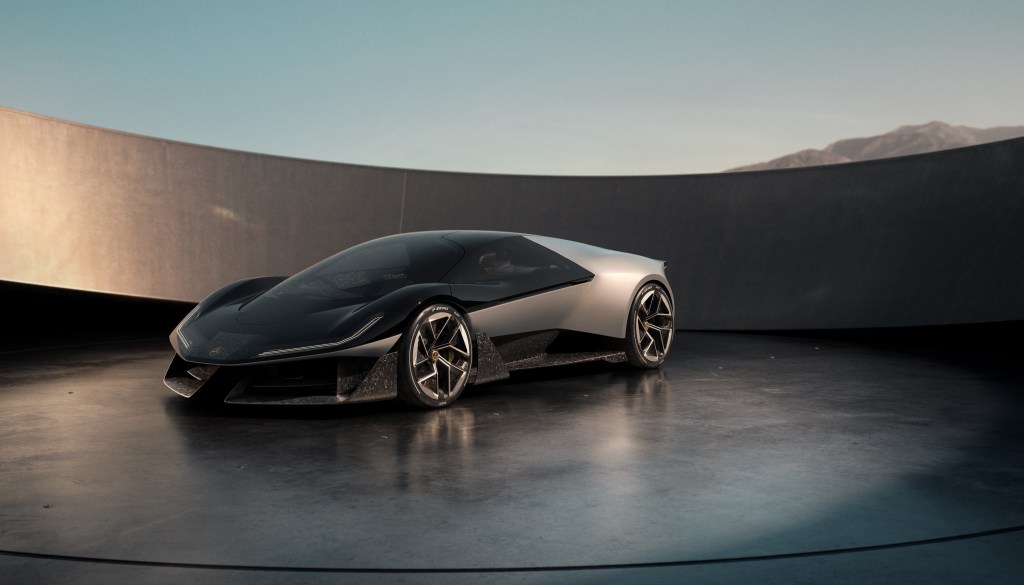
Lotus has unveiled a new performance car.
While the Theory 1 is only a concept, Lotus calls the electric vehicle its design manifesto, which will form the foundation for all its future cars. The Theory 1 is said to encapsulate the company’s three core principles of digital, natural and analogue (DNA).
“With Theory 1, we’ve built on everything Lotus has achieved so far in its 76-year history, to push the boundaries for what it means to drive a performance vehicle,” said Ben Payne, Lotus Group vice president of design, in a news release. “We want to demonstrate that you don’t need to compromise – with both digital and analogue capabilities working harmoniously in the future car. In doing this, we are able to bring drivers the best possible immersive driving experience with raw emotion, functionality and connectivity, at the core.”
The Theory 1 is a three-seater, driver in front and two passengers on either side behind the driver.

It’s powered by a 70-kWh battery powering an all-wheel-drive electric powertrain with a horsepower rating of 986 hp.
Lotus says the car accelerates from zero to 100 km/h in less than 2.5 seconds and the car’s top speed is 320 km/h.
The car weighs less than 1,600 kilograms.
Driving range is estimated at 402 kilometres.
A driver system called Lotuswear features adaptive soft and lightweight robotic textile material that enables the car to communicate with the driver and passengers and provide a more intuitive and comfortable experience, Lotus says. Inflatable pods on the seating and steering wheel react in real time to offer more support, grip.
The system also offers prompts through haptic feedback, such as pulses on the left and right sides of the steering wheel indicating when the driver should make a turn.

There are a variety of driving modes, so drivers can choose between comfort and performance settings.
Other nifty items that are part of Lotuswear include 3D-printed lattice structures in the headrests to increase comfort and reduce weight. An audio system that’s part of the headrest, designed in collaboration with KEF, offers individual bespoke soundscapes for each occupant.
On the performance side, the car features active and passive aerodynamic to enhance stability and to increase the lightness of the vehicle.
The car also uses its motor and battery assembly to take the forces directly from the suspension, reducing complexity and weight, without a need for a subframe.
The rear wing was mounted directly to the motor and suspension assembly to ensure the downforce acts directly on the suspension mounts, to the tires, reducing losses and frontal lift. The rear suspension also features a pull rod design that is compact and lowers the centre of gravity.
The purpose of the wild doors is to allow all occupants to easily get in the car. Lotus says the doors were designed to let occupants get in and out even in tight parking spots.
 Empty Tank
Leave a comment